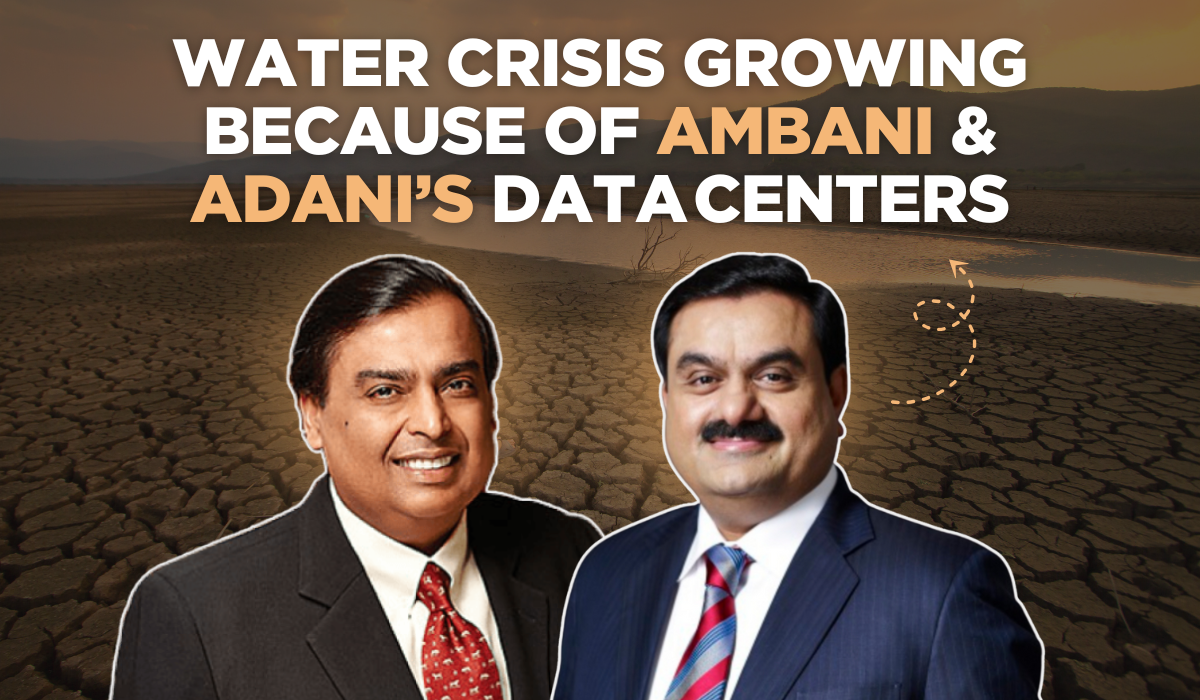
Ambani Adani Data Center Project: India is racing to become an AI superpower, with giants like Reliance and Adani investing billions in building data centers to power AI and digital innovations. But behind the promise of progress, a hidden crisis is brewing—these massive data centers consume enormous amounts of water, pushing already stressed water resources to the brink.
This article explores how India’s booming AI ambitions threaten its water security, the environmental costs involved, and what you need to know as a beginner about this complex issue. India’s effort to lead in AI technology through the establishment of huge data centers is causing a surge in water shortages that result in environmental and social crises. Discover the whole story here.
How AI Data Centers in India Power AI and Why They Put Water at Risk?
What Are Data Centers?
Data centers are big places that have thousands of servers. They are the ones that store and process the data needed by AI applications such as ChatGPT, autonomous vehicles, and cloud services. They are frequently referred to as the “brains” of AI because, essentially, without them, the present-day smart technologies would not be able to work smoothly.
Why Do Data Centers Use Water?
- Cooling Servers: Servers heat up very much. To avoid the situation where the temperature goes too high, it is necessary to use some kind of cooling systems. In most cases, these systems use water as a medium to absorb heat.
- Water-Intensive Cooling Technologies: There are some cooling units, for instance, those that operate on the principles of evaporation or humidification, which take in billions of liters of water yearly.
The Global Impact – Ambani Adani Data Center Project
The amount of water that is used for data centers is very large,
- In the States, one data center used around 17 billion gallons of water in 2023.
- The estimations point to a situation where the use of water worldwide for AI data centers may be more than 1,000 billion liters (1.068 trillion liters) by 2028.
India’s Water Crisis Due to Data Centers and the Role of Data Centers
The Water Shortage Challenge
India is in dire need of water:
- More than 600 million people live in areas where the water is highly or extremely scarce.
- While the tech parks are rapidly growing, cities like Bengaluru, Mumbai, and Hyderabad are already struggling with water shortages.
Recent Incidents and Evidence
- Due to overexploitation, Bengaluru, which is commonly referred to as India’s Silicon Valley, is running out of local water sources and therefore, is witnessing repeated water protests.
- The Google-Adani data center proposal in Vizag (Visakhapatnam) might elevate the depletion of groundwater, particularly since the area is subjected to irregular rainfall and increasing water demand.
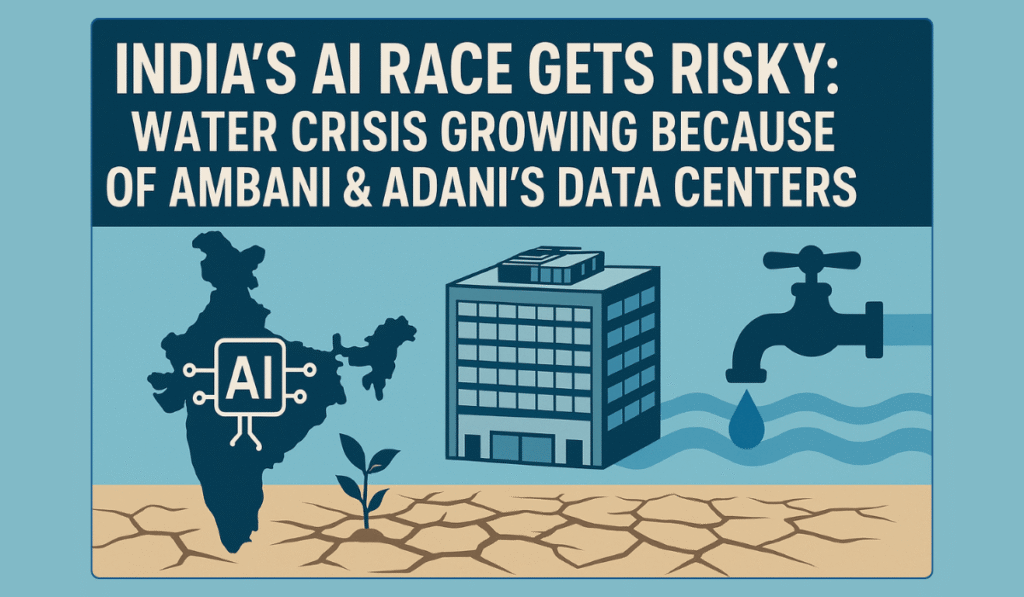
Real-Life Example: The Water-Intensive Google-Adani Data Center
HRF, an environmental research organization, warns that the Vizag project could divert valuable groundwater, lead to contamination, and overburden the local water supply—while giving very few advantages to the local community.
Myth-Busting: Is Green Energy the Solution?
It is being put forward by some that renewable energy can make data centers eco-friendly, but this is not a complete fact:
| Myth | Reality |
| Data centers can operate entirely on renewable energy | In reality, India’s grid cannot supply 24/7 renewable power, so fossil fuels still play a major role, especially during peak demand |
| Water use in data centers is negligible | Water consumption for cooling remains a critical environmental issue, especially in water-stressed regions |
What Can Be Done? Actionable Steps for a Sustainable Future
- Prioritize Water-Efficient Cooling: Data centers must transition to closed-loop cooling systems that significantly lessen water consumption.
- Strategic Location: Place data centers where there is ample water supply, thus, reducing local water scarcity.
- Invest in Renewable and Storage: Make use of clean energy sources combined with battery storage to lessen the carbon footprint.
- Relax Water Policies: Inflict more severe punishment for illegal water use. For instance, in case of data centers, which require a lot of water, certain laws should be imposed most strictly.
Comparison Table: Traditional vs AI Data Center Water Use
| Aspect | Traditional Data Centers | AI Data Centers |
| Water Consumption | Moderate, mainly for basic cooling | Extremely high, especially for AI training & cooling |
| Power Source | Mainly grid, mix of fossil & renewables | Growing dependence on fossil fuels, some renewable efforts |
| Environmental Impact | Manageable with proper regulations | Significant, worsened by water shortages and emissions |
FAQ’s – Ambani Adani Data Center Project
Q1. Why are data centers such big water consumers?
Ans: Water is the primary means of cooling servers and other hardware in data centers that generate heat as a result of operation. The facilities need cooling towers, chillers, and heat exchangers to cool the equipment efficiently, and the devices require water for heating and cooling to a significant extent. In addition, water is used in the fire protection and humidification systems. Thus, with the rise of AI and digital services, the demand for cooling and thus water consumption is going up exponentially.
Q2. How much water does a data center typically use in a year?
Ans: A data center of moderate scale can be responsible for the consumption of about 110 million gallons of water in a year, of which the majority goes to cooling. Hyperscale facilities, particularly those supporting AI workloads, can have a water consumption level ranging from 300,000 to 5 million gallons per day— which is equivalent to the water consumption of a small city! This shocking demand exacerbates issues of water scarcity in regions such as India.
Q3. What is Water Usage Effectiveness (WUE), and why is it significant?
Ans: WUE is an essential metric for describing the water use efficiency of data centers. The calculation involves dividing the water used (in liters) by the energy consumed (in kilowatt-hours). The value of WUE is inverse to water efficiency, that is, the lower the WUE, the better. For instance, the average industry WUE could be 1.80 liters of water per kWh, but some data centers are striving to achieve more through creative methods of cooling.
Q4. Are data centers capable of being green if they consume a lot of water?
Ans: They can, if a company implements measures like using different cooling technology that is more water efficient, taking water from sources that have been recycled, and building its data center where there are plenty of water resources. For instance, companies like Microsoft are adopting adiabatic cooling that is based on outside air rather than water to reduce water consumption by 95% in some operations. Nevertheless, considerations such as regional regulations and the impact on the environment remain important factors.
Conclusion: the Responsibility to Ensure Sustainable AI Growth
India’s AI expansion at a brisk pace provides a variety of economic and technological advantages; however, it entails significant environmental implications, mainly the shortage of water, which has the potential to affect the lives of millions. The government, corporate sector, and citizens must, thus, promote the use of data centers that are water-efficient and of energy that is sustainable.
Your Next Steps
- Keep yourself updated about environmental regulations concerning tech infrastructures.
- By green tech adoption, support the companies.
- The awareness about the hidden costs of digital technology you can increase by educating others.
While AI is still progressing, the challenge of balancing breakthrough with environmental care will be the key to a sustainable future. Join the wave of change by requesting from tech giants that they be transparent and implement eco-friendly practices.
For more important information explore – onlinefinancetips.com