Quick Summary
Creating a budget is only the first step – following it correctly is what leads to financial success. In this guide, you’ll discover the 5 most common budgeting mistakes in 2026, understand how they affect your finances, and learn practical strategies to manage your money more effectively and achieve your long-term financial goals.
Key Takeaways
- Avoid the 5 most common budgeting mistakes in 2026.
- Track every expense to identify unnecessary spending.
- Set realistic financial goals and review your budget regularly.
- Build an emergency fund to handle unexpected expenses.
- Stay consistent with your budget for long-term financial success.
Best For
Students, Families & Working Professionals
Main Goal
Avoid common budgeting mistakes and save more money
Action Required
Review your monthly budget and fix these 5 mistakes
Avoid Budgeting Mistakes in 2026
In today’s blog, we will discuss that one budgeting mistakes which can ruin any budget. Plus, you’ll learn a practical, easy-to-apply fix. So sometimes you find yourself overeating your budget then you’re in the right place!
Have you ever think, “Where does all my money go every month?” You’re not alone! Everyone knows how to make a budget, but there’s some budgeting mistakes that can destroy even the best budgets – even for experts! Don’t worry – fixing it is easier than you think.
Why Budgeting Is More Important in 2026
- Every Year Inflation and living costs are rising, so without a plan, saving money becomes difficult for anyone. That’s the reason we need to start planning our finances as soon as possible.
- Emergencies don’t announce themselves – you need to be prepared.
- If you don’t fix bad habits now, financial stress in the future will grow.
- Financial planning gives you more control over your money and your goals!
“People who don’t make a budget are often shocked when they realize how quickly their money vanished without them noticing!”
| Budgeting Mistake | Better Habit |
| Not tracking monthly expenses | Record every expense using a budgeting app or notebook. |
| Ignoring an emergency fund | Save at least 3–6 months’ worth of essential expenses. |
| Impulse buying | Follow the 24-hour rule before making non-essential purchases. |
| Using credit cards without a repayment plan | Pay the full balance every month to avoid interest charges. |
| Never reviewing your budget | Review and adjust your budget at the end of each month. |
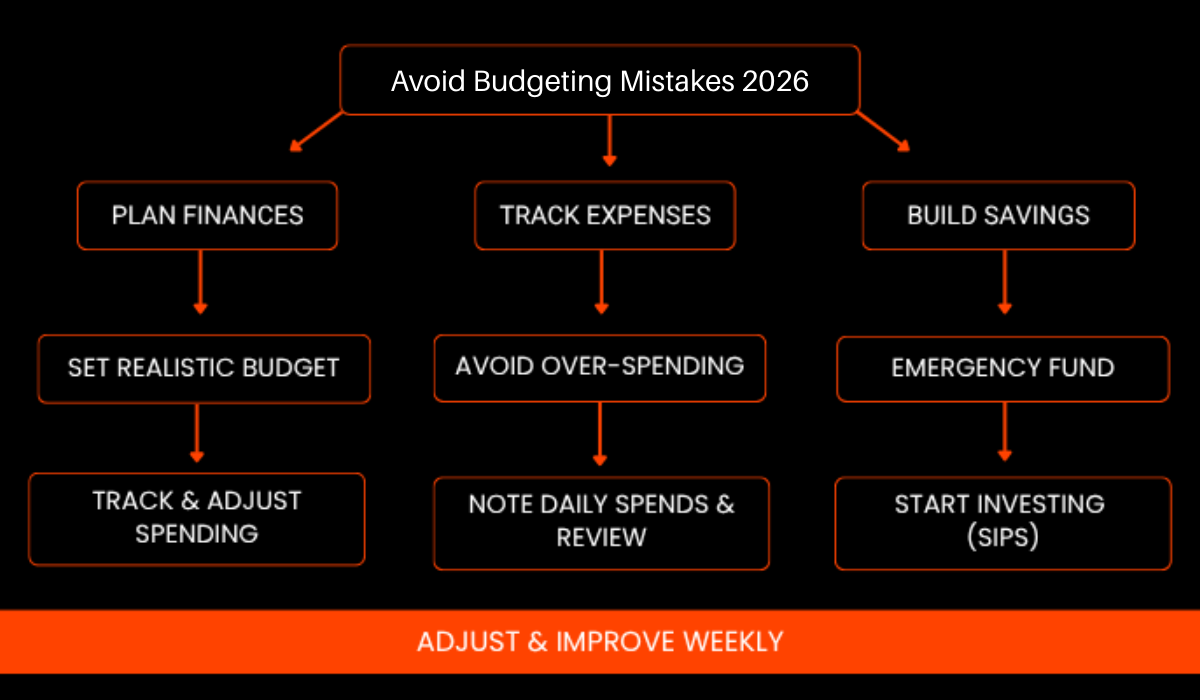
The 5 Budgeting Mistakes
1. Not Tracking Your Expenses
- List all your income and all expenses.
- Always allocate some portion of your income separately for savings, spending, and bills.
- You can use simple tools like Excel, a notebook, or anything that feels easy for you to manage things.
- Example : ₹15,000 Income: ₹10,000 spending, ₹3,000 saving, ₹2,000 bills.
2. Not Having an Emergency Fund
- Try to save 3 to 6 months worth of expenses.
- Emergency Funds help you to tackle unexpected conditions like medical emergencies or job loss.
3. Overspending on Wants
- For unexpected expenses, never rely on these trap cards .
- Track your spending regularly, If needed use a separate account for spending money, and try to avoid credit cards.
4. Ignoring Debt Repayments
- Start with small funds, Starting from SIPs is a good idea to start your investment journey. SIPs can be as low as ₹500.
- PPF, mutual funds, and stocks all have different risk and return levels.
- The earlier you start, the more you benefit from compounding.
5. Never Reviewing Your Budget
- These terms helps you to save lot on your taxes : EPF, PPF, ELSS, LIC.
- Every year try to review your tax-saving investments.
Expert Advice: What I Recommend
As someone who helps people manage budgets, here is my advice :
- Always keep your spending money in a separate bank account with its own card.
- Review your budget weekly – it only takes 10 minutes.
- Work on your mindset – once you overspend, don’t think ‘I’ve already blown it. Instead, adjust and improve next week.
- Keep your budget realistic, Don’t go for too tight, or too loose.
- If you feel like spending too much money, stop for a moment and think: you’ll need to do an extra step to move money to your account before you can spend it.
FAQs
Q1. What is the best way to start investing in 2026?
Ans: Start with small amounts in SIPs or mutual funds. In SIPs consistency matters more than the amount.
Q2. How much money should I keep aside as saving every month?
Ans: Basically, you have to save minimum 20% of your income, but for initial phase you can start with whatever you can but start building a good saving habit.
Q3. Why insurance? If I already save my money for emergencies too?
Ans: Insurance keeps you safe and confident. If something goes wrong, it stops your saved money from disappearing all at once.
Q4. How does SIPs work?
Ans: SIP stands for Systematic Investment Plan which means investing a fixed amount regularly (e.g., ₹800/month) in mutual funds, helping in making a long-term wealth.
Q5. Can a beginner start with ₹500 investment?
Ans: Absolutely! Starting early and staying regular is more important than the amount.